Dentovio

INBDE cheat sheets

INBDE cheat sheets, scoped to the published blueprint

Every sheet names the Foundation Knowledge and Clinical Content areas it answers to, prints the share of the exam those areas carry, and cites the issuing document and date behind each number. This page is the map: what the 26 sheets cover, what each part of the exam is worth, and what the set leaves out.

26 sheets · 500-item form · weights read from JCNDE's published test specification

36.2%

Diagnosis & Treatment Planning · 181 items

42.0%

Oral Health Management · 210 items

21.8%

Practice & Profession · 109 items

500

Items on one form · published, not estimated

What is on every sheet

Three things a sheet has to declare before it earns a place here.

Declared coverage

Each sheet prints the Foundation Knowledge and Clinical Content areas it answers to, in the exam's own codes. You can hold a sheet against the score report a failing candidate actually receives, which reports across the three component sections and the ten Foundation Knowledge areas, and see which part of it the sheet speaks to.

Declared weight

Each sheet prints the share of the exam its areas carry. The section figure is published by JCNDE. The per-sheet figure is our own arithmetic and is labelled an estimate every time it appears — including on this page.

Declared source

Every number carries the document it came from and the date that document was issued. Where two authorities disagree, both values print and the row is marked as one not to key an answer on. Where no number exists, the absence prints instead of a guess.

The published test specification

The whole exam, on one grid.

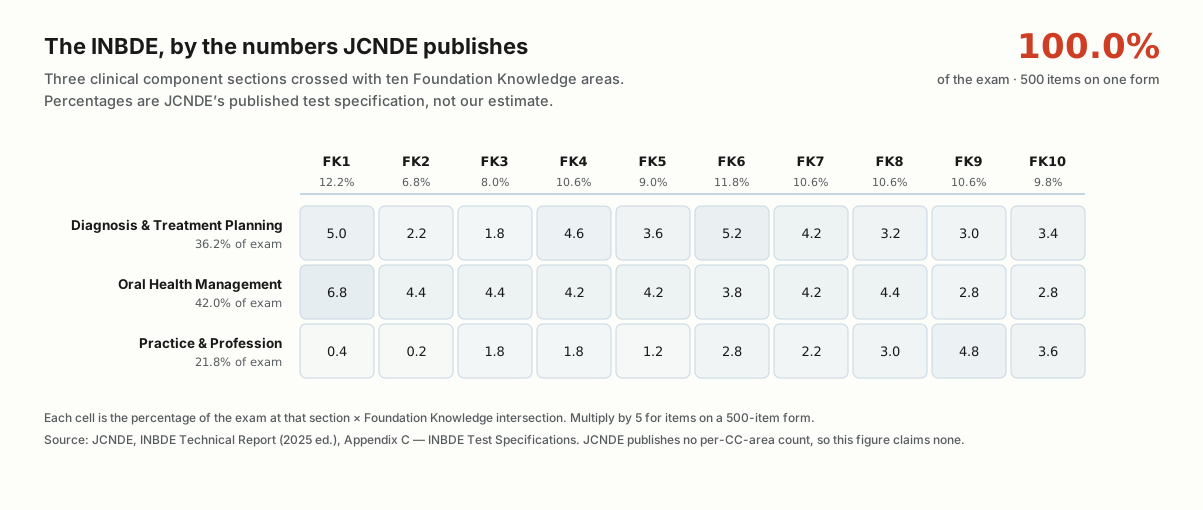
The whole exam on one grid. Rows are the three clinical component sections, columns are the ten Foundation Knowledge areas, and each cell is the percentage of the exam at that intersection. Multiply any figure by 5 for items on a 500-item form.

The published INBDE test specification as a three-by-ten grid. Rows are the three clinical component sections — Diagnosis and Treatment Planning at 36.2 per cent, Oral Health Management at 42.0 per cent, and Practice and Profession at 21.8 per cent. Columns are the ten Foundation Knowledge areas, with published column totals from 6.8 per cent at FK2 to 12.2 per cent at FK1. Each of the thirty cells shows the percentage of the exam at that intersection.

Source: JCNDE, INBDE Technical Report (2025 edition), Appendix C — INBDE Test Specifications. Open the Technical Report

The three clinical component sections

JCNDE publishes one weight per clinical component section, and those three numbers decide how much of your preparation each part of the exam deserves. Oral Health Management is nearly twice Practice & Profession.

Clinical component sectionClinical content areasPublished shareItems on a 500-item form
Diagnosis & Treatment Planning CC1–CC151536.2%181
Oral Health Management CC16–CC382342.0%210
Practice & Profession CC39–CC561821.8%109

Source: JCNDE, INBDE Technical Report (2025 edition), Appendix C — INBDE Test Specifications. Item counts are the published percentage multiplied by 5, because one form carries 500 items.

The index

All 26 sheets, and what each one is worth.

The set is built in four waves, in descending order of estimated exam share, with two deliberate exceptions: the cross-cutting numbers index ships first because it is what every other sheet cites, and two low-share sheets ship early because a wrong number in those areas is the kind of wrong number that matters most.

Availability

None of the 26 sheet bodies is published yet. A sheet body is clinical content, and Dentovio does not publish INBDE clinical material until it clears the credentialed-review gate that governs every clinical file in the product — the same gate that makes a file vanish from the site the moment its text changes. This index is publishable today because it contains no clinical content: it describes the exam's published structure and our weighting method, and nothing else.

Wave 1 — first out

The numbers index every other sheet cites, plus the two areas where being wrong costs the most and the single largest sheet in the set.

Sheet 1

Not weighted

Numbers, and the Document Behind Each One

numbers-and-sources

Its rows already count inside the sheets below, so it is not weighted again.

The cross-cutting index: every number the other sheets use, each one printed next to the document and date it came from.

FKFK1FK2FK5FK6FK7FK8FK9
CCCC1CC7CC8CC10CC16CC18–CC23CC26CC27CC32CC33CC51

Not yet published

Sheet 2

1.83%

Medical Emergencies in the Chair

medical-emergencies

estimated · about 9 of 500 items

One decision path from the first sign to the action, with each step tied to the source that defines it.

FKFK8FK1FK6
CCCC16

Not yet published

Sheet 3

1.83%

Local Anesthesia & Pain Control

local-anesthesia

estimated · about 9 of 500 items

The calculation shown as a calculation, so the working is inspectable rather than memorised.

FKFK8FK1FK2
CCCC19

Not yet published

Sheet 4

9.65%

Reading the Patient Box

patient-box

estimated · about 48 of 500 items

How to read the case chart in the order the exam rewards, and which zones change the answer.

FKFK9FK6
CCCC1CC2CC11CC15

Not yet published

Wave 2 — Diagnosis & Treatment Planning

36.2% of the exam, and the block most prep material treats as an afterthought because it has no tidy discipline name.

Sheet 5

7.24%

Diagnostic Tests & Choosing the Image

diagnostic-tests

estimated · about 36 of 500 items

Which test the question is actually asking you to select, and what each one can and cannot settle.

FKFK2FK3FK6FK10
CCCC6CC7CC10

Not yet published

Sheet 6

4.83%

The Medically Complex Patient

medically-complex

estimated · about 24 of 500 items

One risk table instead of several that disagree, with every unsettled threshold marked as unsettled.

FKFK6FK5FK8FK4
CCCC8CC9

Not yet published

Sheet 7

4.83%

Diagnosis, Prognosis & Sequencing

treatment-planning

estimated · about 24 of 500 items

The order a plan is built in, drawn so the re-evaluation point is visible as a decision.

FKFK6FK10
CCCC4CC12

Not yet published

Sheet 8

4.83%

Head, Neck & Intraoral Examination

examination

estimated · about 24 of 500 items

The examination as a sequence, because the order the exam expects is itself the content.

FKFK1FK6
CCCC3CC5

Not yet published

Sheet 9

4.83%

Consent, Communication & Patient Attributes

consent-communication

estimated · about 24 of 500 items

What has to be established, in what order, and what the record has to show afterwards.

FKFK9
CCCC13CC14

Not yet published

Sheet 10

Not weighted

Exam English & the Patient-Box Sentence

exam-english

Scoped to the 200 of 500 items delivered inside a case rather than to a clinical content area.

How the stem verbs work and what each one is asking for — written for candidates reading in a second language.

Not yet published

Wave 3 — Oral Health Management

42.0% of the exam — the largest section, and the one most study lists already recognise.

Sheet 11

7.30%

Restoring Form, Function & Esthetics

restorative-esthetics

estimated · about 37 of 500 items

Four clinical content areas that rarely get a sheet of their own, including how outcomes are evaluated.

FKFK3FK1
CCCC30CC36CC37CC38

Not yet published

Sheet 12

4.86%

Prosthodontics, Implants & the Lab Prescription

prosthodontics

estimated · about 24 of 500 items

The geometry drawn rather than described, plus what the written instruction to the laboratory has to carry.

FKFK3FK1
CCCC29CC31CC56

Not yet published

Sheet 13

3.65%

Prescribing & Drug Complications

prescribing

estimated · about 18 of 500 items

Built around the prescribing decision the exam tests, not around a drug-class catalogue.

FKFK8FK7
CCCC26CC27

Not yet published

Sheet 14

3.65%

Dental Emergencies, Trauma & Hemorrhage

dental-emergencies

estimated · about 18 of 500 items

Time-dependent decisions laid out on their real axes, each keyed to the guideline edition it comes from.

FKFK6FK7FK1
CCCC17CC18

Not yet published

Sheet 15

3.65%

Pulpal & Periradicular Disease

endodontics

estimated · about 18 of 500 items

The dual-diagnosis grid typeset as a table, read from the finding towards the name.

FKFK7FK6FK1
CCCC20CC28

Not yet published

Sheet 16

3.65%

Oral Surgery: Decide, Then Do

oral-surgery

estimated · about 18 of 500 items

The decision before the procedure, and the complication paths that follow from it.

FKFK1FK6
CCCC32CC33

Not yet published

Sheet 17

3.65%

Occlusion, TMD & Orthodontic Problems

occlusion-tmd-ortho

estimated · about 18 of 500 items

Two clinical content areas held on one sheet, with the classifications drawn as geometry.

FKFK1FK3
CCCC34CC35

Not yet published

Sheet 18

3.65%

Abuse, Neglect & Substance Use

abuse-substance-use

estimated · about 18 of 500 items

Duties that vary by jurisdiction, drawn as a fork instead of flattened into one national rule.

FKFK9FK6FK8
CCCC24CC25

Not yet published

Sheet 19

3.04%

Caries: Risk, Diagnosis & Prevention

caries

estimated · about 15 of 500 items

Risk assessment through to recall interval, with the population-health area it connects to.

FKFK2FK7
CCCC21CC52

Not yet published

Sheet 20

1.83%

Periodontal Diseases

periodontics

estimated · about 9 of 500 items

The current classification as a table, with the edition and date it was published.

FKFK5FK6FK7
CCCC22

Not yet published

Sheet 21

1.83%

Oral Mucosal & Osseous Disease

mucosal-osseous

estimated · about 9 of 500 items

Recognition organised by what you see first, with the nearest confusable named on every entry.

FKFK5FK6FK4
CCCC23

Not yet published

Wave 4 — Practice & Profession

21.8% of the exam. Last by design: this is where our own question bank is already deepest, and sheets go where the drilling is thin.

Sheet 22

6.06%

Evidence, Population Health & Collaboration

evidence-public-health

estimated · about 30 of 500 items

Study design through to what a given measure can and cannot support — the home for FK10.

FKFK10FK9
CCCC39CC40CC41CC53CC54

Not yet published

Sheet 23

3.63%

Ethics & the Limits of Your Scope

ethics-scope

estimated · about 18 of 500 items

The principles mapped, with the duty to refer shown as an endpoint rather than a footnote.

FKFK9
CCCC42CC45CC50

Not yet published

Sheet 24

3.63%

Jurisprudence, Records & Risk

jurisprudence-records

estimated · about 18 of 500 items

Three clinical content areas that are usually compressed into a paragraph somewhere else.

FKFK9
CCCC44CC46CC47

Not yet published

Sheet 25

3.63%

Practice, Team & Quality

practice-team-quality

estimated · about 18 of 500 items

Supervision, delegation and quality as an ordered ladder rather than a glossary.

FKFK9FK10
CCCC43CC49CC55

Not yet published

Sheet 26

2.42%

Infection Control & Preparedness

infection-control

estimated · about 12 of 500 items

Classification through to processing method, with the standard and its date on every row.

FKFK7FK5
CCCC48CC51

Not yet published

About the estimate

JCNDE publishes no per-clinical-content-area weight. The section weights above are published. The per-sheet figure is Dentovio arithmetic — equal allocation across the section's clinical content areas — and is labelled an estimate everywhere it appears. See the full arithmetic.

The absences, printed

What this set does not cover.

A study set’s gaps are usually invisible: you finish the material and never learn what was missing from it. These are ours, in writing.

No standalone anatomy sheet

FK1 carries 12.2% of the exam, more than any other Foundation Knowledge area — but anatomy is not a clinical content area, and the exam tests it through a clinical decision rather than on its own. It is carried inside the examination, anesthesia and oral-surgery sheets. Every sheet prints its FK codes, so you can audit that coverage yourself against the score report.

No standalone physiology, microbiology or immunology sheet

Same reason: they are foundation knowledge, tested through the clinical areas that use them. FK10 is the exception. At 9.8% of the exam it is concentrated in one place, so research methodology and analysis gets a sheet of its own rather than being scattered.

No radiographic landmark atlas

We do not hold a landmark-by-landmark corpus we can source, and we will not publish a picture atlas we cannot cite. Recognition material rides inside the sheet that tests the decision it belongs to. This omission is printed here rather than left for you to discover halfway through a study block.

No tooth-morphology sheet in this version

Out of scope for the first 26, and recorded openly. Writing unreviewed morphology to fill a hole in a comparison table is the kind of shortcut this repository has already paid for once.

And what nobody publishes

  • JCNDE publishes no per-clinical-content-area item count. The Item Development Guide states those allocations go to test constructors privately, so no sheet claims one.
  • JCNDE does not publish a scored-versus-pretest split for the 500 items on a form.
  • JCNDE publishes no candidate-performance breakdown by content area, so there is no defensible claim about which areas candidates find hardest — and we make none.
  • The exam is not changing in 2027. On JCNDE's current published roadmap, subject-matter expert panels recommend specification updates in 2027 and new performance standards follow in 2028 — and no implementation date is published.

How we weight them sets out each of these gaps in full, with the document behind it.

Before you plan around any of this

Take the free INBDE readiness mock

The weights tell you what the exam is made of. They do not tell you where you stand in it. The free readiness mock is original, exam-style, and scored against the same blueprint structure this page describes — nothing to buy, and no score prediction.

Sources

Last verified 2026-08-05

INBDE® is a registered trademark of the American Dental Association, administered by the Joint Commission on National Dental Examinations (JCNDE). Dentovio is an independent prep provider and is not affiliated with, endorsed by, or sponsored by JCNDE or the ADA.

Dentovio provides independent educational preparation using original exam-style material. It is not affiliated with or endorsed by JCNDE, PSI, or any dental board, and it does not reproduce recalled exam questions.

This page describes exam structure and Dentovio's weighting method. It contains no clinical guidance, and nothing on it is legal, clinical, or licensure advice. Exam specifications change on JCNDE's schedule — confirm current requirements in JCNDE's own materials before you plan around them.